


The oldest traces or fossils of olive trees have been found in the Eastern Mediterranean region, specifically:
- Santorini (Greece): One of the most impressive discoveries is fossilized olive leaves found in Akrotiri, Santorini, dating back approximately 60,000 years. These leaves were preserved in volcanic material, proving the existence of wild olive trees in the region before human activity.
- Karaburun, Turkey: In this area of Eastern Turkey, traces of olive pollen dating back approximately 23,000 years have been found, indicating the presence of wild olive trees.
- Gavdos Island (Greece - South of Crete): Fossilized olive trees dating back around 50,000 years have also been discovered here, further confirming the existence of wild olives in the region.
- Israel and Jordan: Evidence of olive cultivation has been found in these areas, dating back to approximately 6,000 BC, considered among the earliest signs of the plant's domestication.
In the region of Kyme, Euboea (Greece), a fossilized olive leaf was discovered, estimated to be around 10,000 years old. This finding is particularly significant as it is one of the oldest pieces of evidence of olive presence in the Greek territory. The fossil was found within geological formations, proving that the olive tree existed in the area since the last period of the Pleistocene epoch. It belonged to the wild olive species (Olea europaea), highlighting the tree’s resilience over time and its adaptability to Mediterranean climatic conditions.
This discovery reinforces the view that the Eastern Mediterranean, and specifically Greece, is one of the natural cradles of the olive tree, even before human cultivation.
These findings demonstrate that the olive tree has deep roots in the Eastern Mediterranean, thriving both as a wild plant and as a systematically cultivated species with the development of early human civilizations.
Origins and Early Cultivation
The olive tree is one of the oldest trees cultivated by humans. The first traces of wild olive trees (Olea europaea) date back approximately 20,000 years in the Mediterranean region. However, its systematic cultivation began around 6,000 BC in the Middle East, particularly in the area of Syria and Palestine. From there, cultivation spread to the Mediterranean coasts.
The Olive Tree in Minoan and Mycenaean Civilization
In Crete, during the Minoan civilization (2000-1450 BC), olive cultivation played a crucial role in the economy and diet. The Minoans were the first to develop techniques for extracting olive oil, which they used for food, cosmetics, and religious rituals.
During the Mycenaean period (1600-1100 BC), the olive tree held a central place. Linear B inscriptions mention the management of olive oil as a key element of trade and economy.
The Expansion of the Olive Tree in the Classical World
The Ancient Greeks spread olive cultivation to regions such as Italy, Sicily, and Spain. Athens even considered the olive tree a sacred plant, dedicated to the goddess Athena. According to myth, the goddess gifted the first olive tree to the Athenians, thus winning their favor.
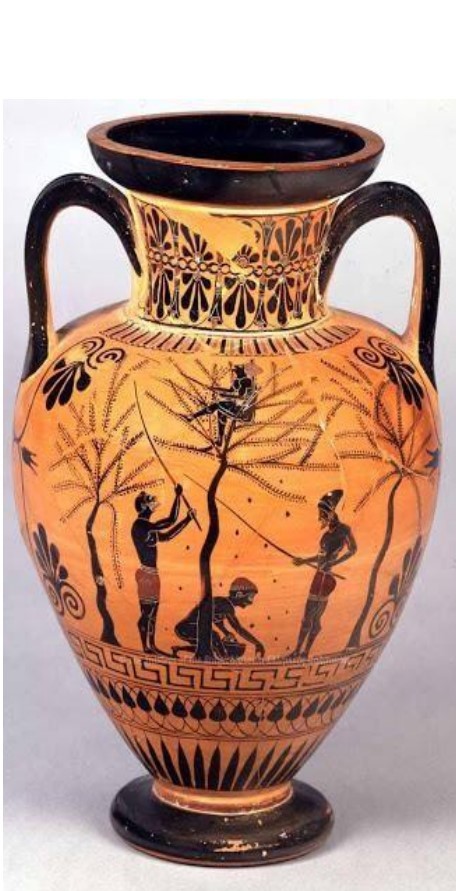
One of the oldest depictions of olive harvesting is found on an Attic black-figure amphora attributed to the Antimenes Painter, around 520 BC, discovered in Vulci, Italy.
The Romans continued olive cultivation, improving techniques for growing and extracting olive oil. Olive oil became a staple of their diet and economy, and Roman roads facilitated its transport across the empire.
Medieval Period and Renaissance
During the Middle Ages, olive cultivation was limited to specific areas due to wars and social unrest, which affected production. However, monasteries in the Mediterranean preserved knowledge of olive cultivation, ensuring the continuation of this tradition.
During the Renaissance, the olive tree regained importance as trade expanded and the demand for olive oil increased, both for culinary purposes and as a fuel source for lamps.
The Olive Tree in the Modern Era
Today, olive cultivation is widespread worldwide, with the Mediterranean region remaining the primary producer. Countries such as Greece, Italy, Spain, and Tunisia dominate olive oil production. In Greece, olive cultivation holds immense economic, cultural, and ecological significance, with millions of olive trees covering the countryside.
Symbolism and Cultural Heritage
The olive tree remains a symbol of life, peace, and fertility. In Greek tradition, it continues to hold a central place, both in cuisine and cultural events. Olive oil is considered "liquid gold" and is an integral part of the Mediterranean diet, which is recognized for its health benefits.
The history of olive cultivation is a living testament to humanity’s relationship with nature, demonstrating how a humble tree managed to shape civilizations and inspire generations.