


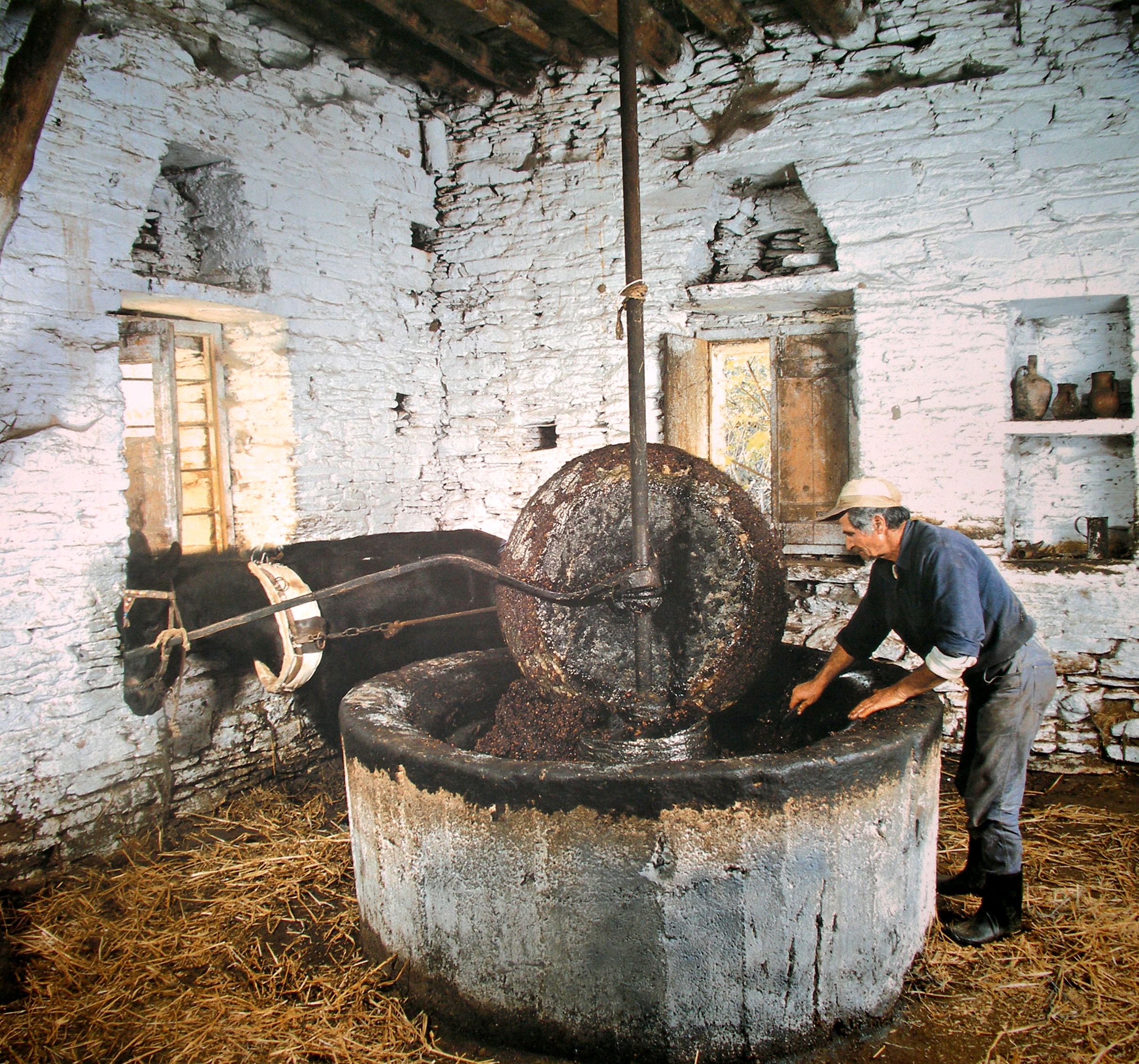
The olives are transported from the fields to the olive mill using animals.
They are received by the miller, who records the order of processing priority. The olives are thoroughly washed with water, which is carried in containers from the nearby well.
They are then placed in large baskets, which serve as the unit of measurement, known as the "stama."
Next, they are emptied for crushing in the stone mill, one or two stama at a time. The mill is horse-driven, turning with the strength of the horse under the guidance of the miller.
Once properly ground, the olive paste is collected by the miller using a special container, placed inside "tsantilia" (large woven sacks that close like an envelope), and roughly sewn shut.
These sacks are stacked in the press, one on top of the other.
The worker begins lowering the press manually as much as possible.
Then, a large wooden lever is inserted into the press and pushed by two or even three people to exert more pressure.
The oil begins to flow into the "limpa" (a stone reservoir).
For even better extraction, the "vitzi" is used.
The first oil extracted is of the highest quality, known as "athermisto" (unheated), and is collected separately.
Once the pressing is complete, the press is lifted, the sacks are opened, hot water is poured over the olive paste, and the process is repeated. At this stage, the oil contains hot water, which will later separate in the limpa.
The water is heated in a hearth inside the mill, using firewood and olive pits as fuel.
When the process is complete, the oil is left in the limpa for a while to fully separate from the water and rise to the surface. The miller then carefully collects the oil using a special wooden container and transfers it into leather flasks, from where it is taken by workers to the households.
As the oil level drops (down to where the water begins), the miller uses bundles of reeds, which, when dipped into the limpa and squeezed, release only the oil, as they do not absorb water.
At the start of filling the flasks, the miller takes his "share"—the portion of oil that serves as his and his workers' payment.
The remaining olive pulp in the sacks is emptied and used as fuel for heating water in the mill’s hearth and in villagers' wood stoves for home heating.
This process continues day and night for about three months, lasting the entire olive harvest season.