


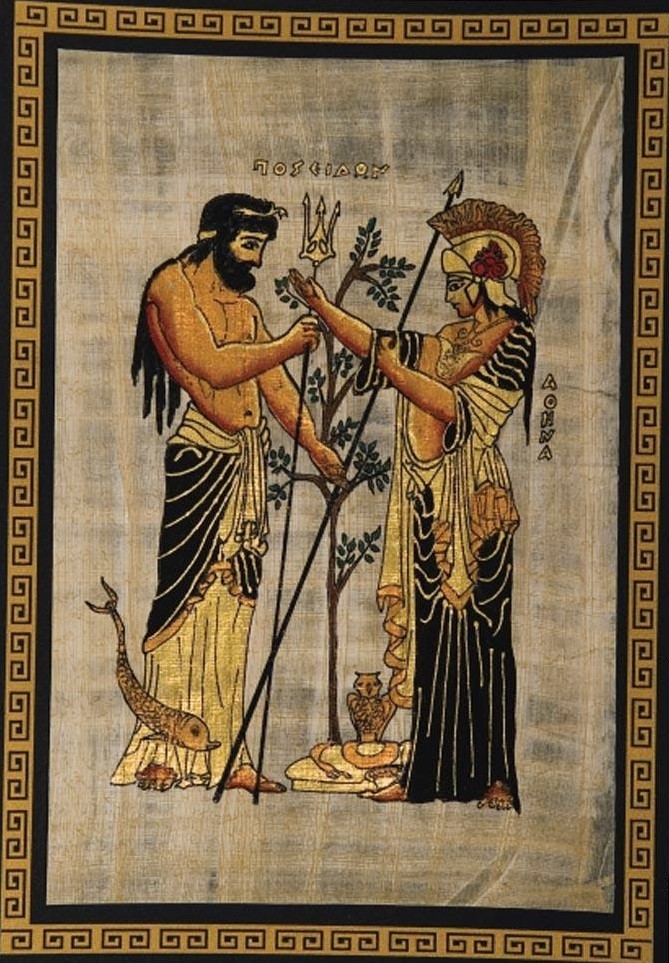
The olive tree held a special place in the ancient Greek world, serving both as a source of life and as a symbol of culture and spirituality. Thriving in Mediterranean regions, this tree was not merely a means of survival but also embodied concepts such as wisdom, peace, and prosperity.
The Myth of the Olive Tree and the Goddess Athena
The origin of the olive tree is linked to one of the most significant myths of ancient Greece. According to tradition, the goddess Athena and the god Poseidon competed for the role of protector of the city of Athens. Poseidon struck the Acropolis with his trident, creating a spring of seawater. In contrast, Athena planted an olive tree as a symbol of fertility and peace. The Athenians deemed Athena’s gift more valuable and declared her the patron deity of their city. Since then, the olive tree has been a sacred symbol of Athens.
Cultivation and Use of the Olive Tree
The cultivation of the olive tree was widespread in ancient Greece as early as the Mycenaean period (1600-1100 BCE). References to the olive tree appear on Linear B tablets, proving its importance in both the economy and daily life. Olive oil, extracted from its fruit, was used in various ways:
• Dietary Use: Olive oil was a staple of the ancient Greek diet, providing both energy and flavor.
• Cosmetic Use: Athletes applied olive oil to their bodies before competitions as part of their grooming rituals.
• Lighting: Olive oil was used as fuel for lamps, providing light in homes and temples.
• Religious Ceremonies: Olive oil held symbolic significance and was used in sacrifices and offerings to the gods.
The Olive Tree as a Symbol and Sacred Tree
The olive tree was considered sacred in ancient Greece. The olive groves of Athens, known as the "Sacred Olives," were protected by law. The destruction of such a tree was considered a serious offense, punishable even by death.
Additionally, winners of the Olympic Games were crowned with the kotinos, a wreath made from wild olive branches. This prize had no monetary value but represented the highest honor and glory.
The Olive Tree in Poetry and Philosophy
The olive tree frequently appears in ancient Greek literature as a symbol of wisdom and longevity. In The Odyssey, Homer describes how Odysseus built his bed using the trunk of an olive tree, highlighting the tree’s strength and stability.
Aristotle also studied the cultivation of the olive tree, recognizing its economic and social significance in Greek society. In his works, he emphasized the tree’s resilience and longevity, as olive trees can live for centuries.
The Olive Tree as a Legacy
In ancient Greece, the olive tree was more than just an agricultural product; it was a bridge between nature and culture, a living testament to humanity’s relationship with the land. Its significance remains timeless, embodying values that continue to define Greek identity: peace, wisdom, and endurance.
The enduring importance of the olive tree in ancient Greece reminds us of the value of this sacred tree, which continues to connect the past with the present and remains a cornerstone of Greek civilization.